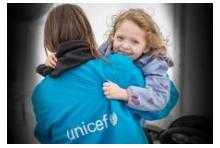
Today, millions of children continue to be caught in humanitarian crises that are growing in complexity and scale. Over 473 million children now live in areas affected by conflict. In conflict and disaster, children suffer first and most and are especially vulnerable to disease, malnutrition, and violence.
UNICEF is on the ground before, during, and after more than 400 emergencies each year, working to support and protect children. UNICEF’s Global Humanitarian Thematic Fund (GHTF) is one of its most effective tools for responding to the needs of children impacted by emergencies in a fast, equitable, and well-prepared manner.
GHTF enables UNICEF to prepare for crises before they occur, deliver life-saving assistance within 48–72 hours of an emergency, and invest in long-term recovery. It also helps ensure equity by directing resources where needs are greatest and filling critical gaps in emergency response.
Examples of UNICEF’s humanitarian response include:
State of Palestine: Despite some improvements since the October 2025 ceasefire, children in the Gaza Strip continue to face extreme health risks after more than two years of conflict and widespread destruction of infrastructure. Since October 2023, 71,803 Palestinians have been reported killed, including at least 21,289 children, and 171,230 injured, including 44,500 children. Despite operating in a highly constrained humanitarian environment, UNICEF and partners continue to deliver life-saving support, reaching 15,689 children under age three through a catch-up immunization campaign and bringing 12,719 children up to date with routine vaccinations, while also supporting over 375,000 children with learning and recreational kits, enabling over 135,000 children to resume learning, expanding nutrition services, and restoring critical hospital care.
Sudan: Ongoing conflict, displacement and disease outbreaks have created one of the world’s largest humanitarian crises for children. An estimated 17.3 million children are in need of humanitarian assistance, with over 9.1 million people internally displaced. Despite severe access constraints, UNICEF and partners continue to deliver life-saving support at scale. In January 2026, 787,800 children were screened for malnutrition, with 25,100 receiving treatments for severe acute malnutrition. UNICEF also supported a measles–rubella vaccination campaign reaching over 540,000 children, provided safe drinking water to 973,000 people, reached over 533,000 children with access to education, and delivered mental health and psychosocial support to more than 121,000 children and caregivers.
Ukraine: UNICEF has been present in Ukraine since 1997 and expanded humanitarian assistance for children and families after the escalation of the war over three years ago. In 2025, UNICEF helped over 1.7 million people access safe water, reached more than 85,000 children with education support, and provided mental health and psychosocial care to over 44,000 children and caregivers, and equipped 900 health facilities received vaccine storage equipment. Inside Ukraine, UNICEF is ensuring children have access to health care, nutrition, education, safe water, mental health support, and more. In refugee hosting countries, UNICEF works with governments and local partners to strengthen national systems that provide refugee children and marginalized children from host communities with quality education, healthcare, and protection services.
From to Yemen to Myanmar, Democratic Republic of Congo to Syria, UNICEF is relentlessly responding to emergencies in countries around the world. With your support UNICEF can continue this critical work providing children with lifesaving services.